

Introduction
Australian buyers are being pulled in two directions. On one side, the RBA’s February 2026 cash rate decision lifted the cash rate to 3.85 per cent. On the other, PropTrack market reporting published by realestate.com.au shows the housing market entered 2026 after a strong 2025, even as economists started talking about slower growth ahead. That mix of high prices, mixed forecasts, thin stock in some suburbs and constant rate chatter can make a sensible buyer feel stuck before they even begin.
The better question is rarely “Can I pick the market perfectly?” It is usually “Am I ready to buy well, borrow safely and hold comfortably?” That is where a good mortgage strategy matters. Buyers comparing timing scenarios can start with Zippy’s home loans guidance, review Zippy’s borrowing power resources and then test how the numbers work for their own income, deposit and plans.
There is no universal right moment to buy. In an uncertain market, the smarter move is to judge timing through personal readiness. If your income is stable, your deposit and buffers are workable, your borrowing capacity is realistic and the property suits a longer-term plan, buying now may make sense. If your finances are stretched, your deposit is still too thin or you are relying on best-case assumptions, waiting and strengthening your position may be the better move. Other options, such as parental and family guarantees, may also help some buyers move sooner.
Key takeaways
- High prices do not automatically mean buyers should wait. Slowing growth is not the same thing as falling prices in every market.
- A quarter-point rate move can still shift monthly repayments enough to affect cash flow and comfort.
- Pre-approval helps buyers move decisively when the right property appears.
- Loan structure matters in uncertain conditions, especially when deciding between fixed, variable and split options.
- Offset and redraw features can be practical tools when used with discipline.
- The best timing decision usually comes from personal readiness, not headlines.
Where the market sits right now
realestate.com.au’s March 2026 property market update reported that Australia’s residential housing value had risen past $12 trillion, with national home prices up strongly through 2025. At the same time, several major banks revised their forecasts lower for 2026 and 2027 as higher borrowing costs began to weigh on sentiment. That creates a market where buyers may still face competition, but where growth expectations are no longer as one-directional as they looked a year earlier.
The challenge is that “the market” is not one single thing. Conditions differ by city, price point and property type. That is why buyers should be careful about using broad national headlines as a substitute for suburb-level thinking, realistic affordability and a proper lending strategy. Buyers considering future investment plans can also review Zippy’s investment loan insights for 2026 to understand how borrowing power and structure change once property goals become more complex.
Why mixed headlines can send buyers in circles
One headline says prices are cooling. Another says supply is too tight. Another says rate cuts may come later. Another says affordability is still biting. All of those things can be true at the same time. Buyers get overwhelmed when they treat each headline as a signal to act immediately. A calmer approach is to separate market noise from decision drivers that actually change your outcome.
What actually matters more than trying to time the cycle
Income stability and buffers
The first test is not price growth. It is whether your income is steady enough to support repayments comfortably now and if needed later. As explained in Savings.com.au’s responsible lending overview, lenders are expected to verify income, expenses and liabilities and assess whether a loan can be repaid without financial hardship. That is why your job stability, spending habits and buffer matter as much as your salary figure.
A useful question is this: if rates rose again or a major household cost jumped, would the mortgage still feel manageable? If the answer is no, that is not a timing problem. It is a readiness problem.
Deposit strength and entry costs
A larger deposit improves flexibility. It can reduce your loan-to-value ratio, lower risk from a lender’s perspective and potentially soften the impact of higher rates. But waiting for a perfect 20 per cent deposit is not always the smartest move either. Some buyers are better off entering sooner with a smaller deposit and a solid income than waiting too long while prices and rents move against them.
Borrowing capacity and spending behaviour
Borrowing power is shaped by more than income. Existing debts, card limits, childcare, living expenses and assessment buffers all matter. Buyers can test scenarios using Zippy’s calculators and then compare those results with a broker-led review. Even small clean-ups, such as trimming a credit card limit or reducing recurring expenses, can materially change how much room you have.
Holding period and purpose
If you plan to hold the property long term, short-term cycles matter less. Buying a suitable home and keeping it through several years of ownership generally matters more than buying at the exact right month. If you may need to sell again in a short timeframe, then transaction costs, risk and timing become more important.
How much do rate moves really change repayments?
Rate changes sound small on paper, but they can feel bigger in a household budget. As a working guide, a 0.25 percentage point rise on a $600,000 principal-and-interest loan over 30 years can add about $95 to $100 a month. On a $400,000 loan, the change is closer to $65. On an $800,000 loan, it can be roughly $125 to $130. That is why buyers should not only ask what they can borrow. They should ask what still feels comfortable if life gets a little more expensive.
Why pre-approval still matters in a messy market
In uncertain conditions, pre-approval acts like a permission slip. Compare the Market’s home loan process guide explains that conditional approval helps buyers search with confidence and is commonly valid for 90 days. That matters because the right property rarely waits for the perfect news cycle. Buyers who know their borrowing range and paperwork position can move without scrambling.
For a more buyer-friendly explanation of the process, Zippy’s pre-approval article is a useful internal read before you start inspecting seriously. It helps frame why finance readiness can be more valuable than trying to guess whether the market will be cheaper six months from now.
Loan structure matters when the outlook is unclear
Fixed, variable or split?
A fixed rate can offer short-term certainty, which some borrowers value when cash flow is tight. A variable rate can provide more flexibility and may suit borrowers who want to make extra repayments or benefit if rates ease. A split structure can sometimes balance both needs. The right choice depends on how much certainty you want, how disciplined you are with cash flow and how long you expect to keep the loan structure unchanged.
Offset and redraw as practical tools
According to Moneysmart’s guide to mortgage offset accounts, an offset account reduces the portion of your loan balance that is charged interest. That can be useful for buyers who keep savings on hand and want flexibility. A redraw facility can also help, though it works differently. In uncertain conditions, these features are not just nice extras. They can become part of your risk-management setup if used sensibly.
Two realistic buyer scenarios
Scenario 1: First home buyer with a 5 to 10 per cent deposit
This buyer has a decent income and stable employment, but not a huge deposit. Waiting another year could improve the deposit and reduce pressure. But if rents remain high and the target suburb keeps moving, waiting may not actually improve their real position. The smarter move may be to check serviceability carefully, budget for all upfront costs and buy only if the repayment plus buffer still feels sustainable.
Scenario 2: Upgrader with strong equity but repayment anxiety
This buyer has equity in the current home and can move without a small deposit problem. The tension is higher monthly repayments. In this case, the right answer may come from loan structure, cash-flow planning and sale or bridging strategy rather than a simple buy-now or wait call. A side-by-side scenario review can reveal whether the move is genuinely affordable now or whether another six to 12 months would improve comfort.
So should you buy now or wait?
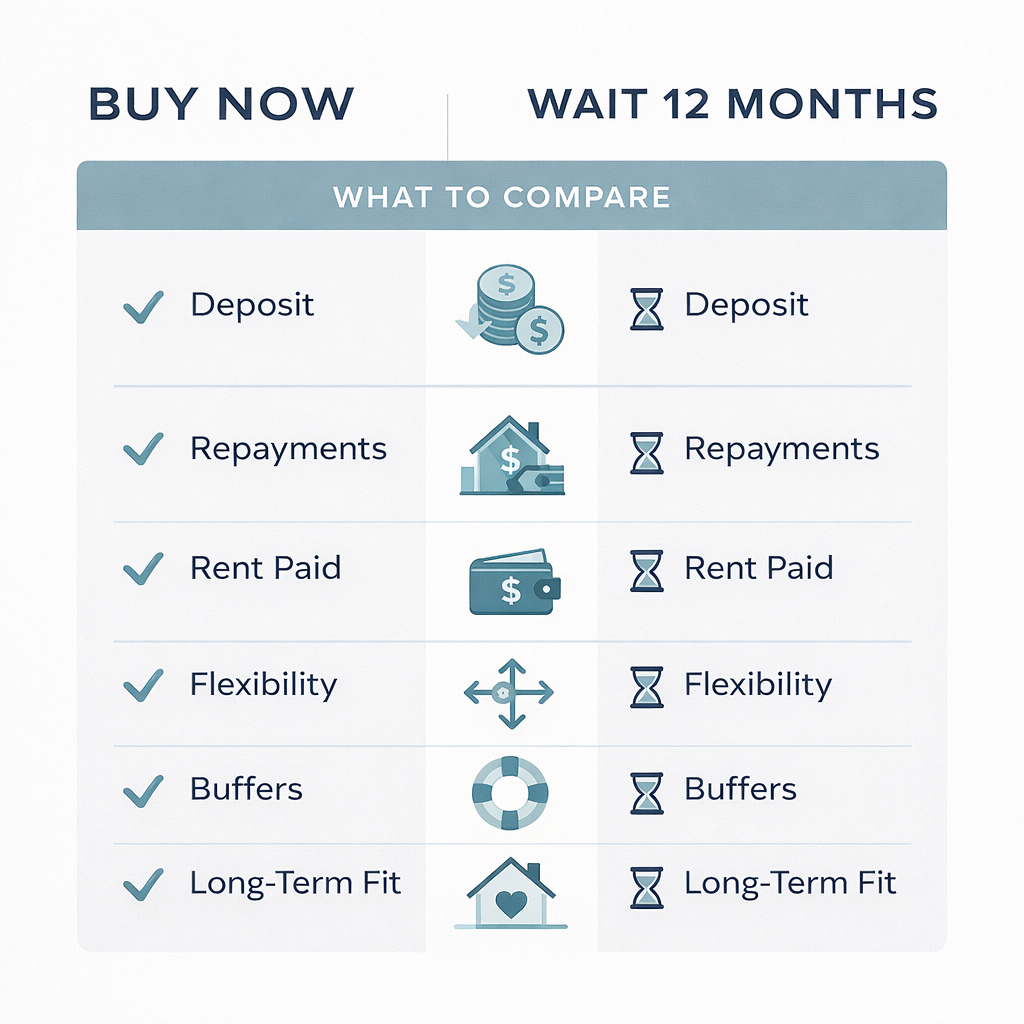
If you are financially ready, buying well now can be more sensible than waiting for a perfect market signal that may never come. If you are not financially ready, waiting can be strategic rather than passive. The point is to decide based on your circumstances, not market theatre. A practical next step is to compare a buy-now scenario against a wait-12-months scenario, review your numbers with Zippy’s home loans team and then use Zippy’s contact page to request a strategy conversation once you know what questions you need answered.
FAQs
Is waiting always safer if rates might fall?
Not necessarily. Rates may ease later, but waiting can also mean paying more in rent, facing higher prices or competing in a tighter market. Safety comes more from your financial buffer than from trying to predict one rate move.
How much difference do small rate changes make to repayments?
Even a small rate change can materially affect monthly cash flow. On a mid-sized home loan, a quarter per cent move can change repayments by around $65 to $100 a month depending on the loan size.
Should I get pre-approval before I start seriously looking?
Yes. It sharpens your budget, improves confidence and helps you move faster when you find a suitable property.
What if I have a decent income but only a modest deposit?
You may still be able to buy, but you need to review total entry costs, serviceability and buffer strength carefully rather than looking only at the headline deposit percentage.
Is buying now better if I plan to hold long term?
Often, long-term ownership gives buyers more room to absorb short-term market noise. The key is buying a suitable property with a loan you can manage comfortably.
Take the next step
If you want a calmer way to assess the decision, start by modelling repayments and borrowing power, then book a readiness review through Zippy’s contact page. A buy-now versus wait scenario can often bring more clarity than another week of headlines.
General information disclaimer: This article is general information only and does not take your objectives, financial situation or needs into account. Consider whether any strategy is appropriate for your circumstances and seek professional advice before acting.