

Introduction
For many buyers, the stress in a home purchase is not only about the property. It is the waiting, the paperwork, the lender requests and the fear that one missing document could throw everything off. That is why a clear process matters. Compare the Market’s home loan process guide breaks the journey into simple stages, and those stages provide a good practical map for buyers who want to move from enquiry to settlement with fewer surprises.
Buyers who understand the sequence tend to make better decisions. They prepare documents earlier, respond faster and avoid making financial changes at the wrong time. Internal resources such as Zippy’s home loans page, Zippy’s calculators and Zippy’s location pages can also help buyers line up the practical side before timing becomes urgent.
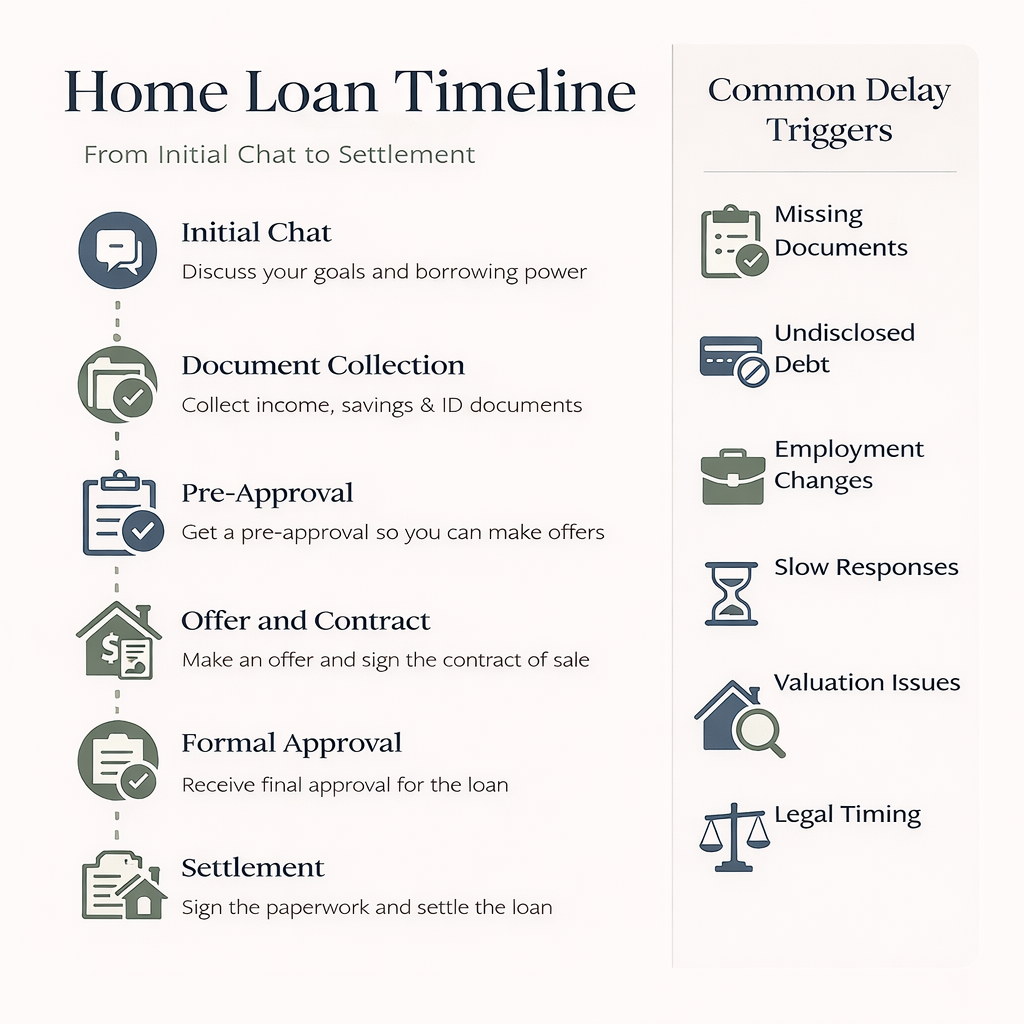
The home loan journey usually moves through six broad stages: the first conversation, document gathering, borrowing-capacity assessment and pre-approval, property search and offer, valuation and formal approval, then settlement. Straightforward applications can move quickly, but delays often happen when documents are missing, debts are not disclosed, employment changes mid-process or buyers respond slowly to lender requests. Preparation is what reduces friction.
Key takeaways
- Pre-approval is often the first serious milestone because it gives buyers a working budget and a finance position.
- Missing paperwork is one of the simplest and most common causes of delay.
- Responsible lending checks are stricter than many buyers expect, which is why lenders ask for so much detail.
- Valuation issues, undisclosed debts and changing jobs mid-process can all slow formal approval.
- Settlement often runs more smoothly when legal, insurance and funds-to-complete are organised early.
Stage 1: Initial chat and goal setting
The first step is a conversation about goals, timing, deposit, income, debts and the kind of property you want to buy. This is where you move from vague hope to a defined plan. Buyers can begin by reviewing Zippy’s home loans service page and then using Zippy’s calculators to get a rough sense of repayments, stamp duty and buying costs before the first formal assessment.
At this point, clarity matters more than perfection. The purpose is to understand your likely range, likely issues and the next documents you will need to pull together.
Stage 2: Fact-find and document collection
This stage is where many delays start or are prevented. Lenders want clear evidence of identity, income, savings, liabilities and spending. Buyers commonly need ID, recent payslips, statements showing debts and expenses, and proof of savings or deposit funds. If you are self-employed or have variable income, expect extra requests.
Good organisation matters here. Missing payslips, half-complete bank statements or unexplained transfers can slow the file before it properly starts. Buyers who gather everything early usually move faster later.
Stage 3: Borrowing-capacity assessment and pre-approval
Once the lender or broker has the core information, the next step is to assess serviceability and issue conditional approval if the application stacks up. A straightforward pre-approval can sometimes be quick, but three to five business days is a more realistic planning range, with complex applications taking longer. Conditional approval is commonly valid for 90 days.
This is the stage where buyers benefit from checking Zippy’s borrowing power guidance and ensuring the requested loan amount still feels sensible rather than just technically possible.
Stage 4: Property search, offer and contract
Once pre-approval is in place, the search becomes more practical. Buyers can inspect seriously, bid with more confidence and make offers with a clearer finance range in mind. The key here is discipline. Pre-approval is not a licence to stretch to your emotional limit. It is simply a guide to what the lender may support subject to final checks.
At offer stage, contract timing becomes important. Finance clauses, cooling-off periods and legal review windows all interact with lender turnaround times. That is why buyers should have their conveyancer lined up before the ideal property appears.
Stage 5: Valuation and formal approval
After you sign a contract, the lender typically orders a valuation and completes final checks. Compare the Market’s home loan process guide indicates formal approval may follow within one to five business days once the contract and supporting checks are in place, though real timing depends on the property, the lender and the file complexity.
This is where lower-than-expected valuations, missing supporting documents or changes in your financial profile can still create problems. Buyers sometimes feel “approved” after pre-approval and forget that formal approval is still a separate milestone.
Stage 6: Settlement and keys in hand
Settlement is the final handover stage, where funds are exchanged and ownership transfers.Compare the Market’s home loan process guide suggests a common application-to-settlement window of around four to six weeks, though contract terms vary. During this period, buyers still need to sign loan documents, organise insurance, confirm funds to complete and keep communication flowing between lender, broker and conveyancer.
If you want a clearer sense of local support and next steps before settlement, Zippy’s location pages and Zippy’s contact page make it easier to move the conversation from research into action.
Why lenders ask for so much information
Many buyers are surprised by how much scrutiny goes into a home loan application. The reason is responsible lending. As outlined in Savings.com.au’s responsible lending overview, lenders need to ask reasonable questions, verify financial details and assess whether the credit is suitable. That means checking income, living expenses, debt levels, credit conduct and how the loan may perform under tougher conditions.
In plain English, lenders are trying to avoid approving a loan that only works if nothing goes wrong. That is why clear documentation and consistent financial behaviour make such a difference.
Common delay triggers buyers should watch closely
- Missing payslips, incomplete statements or ID that does not meet the lender’s requirements.
- Undisclosed debts such as credit cards, buy now pay later accounts or personal loans.
- Changing jobs or moving from salary to probation or contract income mid-process.
- Large unexplained transfers, gambling patterns or spending that raises verification questions.
- Slow replies to lender requests once the file is already in motion.
- Valuation issues, especially on unusual properties or where the contract price looks aggressive.
How to keep the process moving
A good rule is to act as if every document will be requested before it is requested. Have current statements ready, keep payslips accessible, avoid new debt and reply quickly once the lender asks a question. Buyers who want to refinance rather than purchase can also review Zippy’s February 2026 refinance update to see how rate changes can affect the next decision after settlement.
Stage-by-stage snapshot
| Stage | Typical timing | What happens | Common delay risk |
| Initial chat | 1 to 2 conversations | Goals, deposit, income, debts, likely loan pathway | Unclear objectives or unrealistic budget |
| Document collection | A few days to 2 weeks | ID, payslips, statements, liabilities, savings proof | Missing or incomplete paperwork |
| Pre-approval | 3 to 5 business days for many files | Serviceability assessment and conditional approval | Complex income, high debt or slow responses |
| Offer and contract | Varies by property | Search, negotiate, sign and move into formal credit stage | Finance clauses that are too tight |
| Formal approval | Often 3 to 5 business days after final checks | Valuation, final credit review, loan documents | Low valuation or new lender questions |
| Settlement | Often 4 to 6 weeks from contract | Funds move, ownership transfers, keys released | Late documents, late funds or legal hold-ups |
FAQs
How long does pre-approval usually last?
A common planning assumption is about 90 days, but check the lender’s actual terms because expiry periods and refresh requirements can differ.
What documents do lenders usually ask for?
Common requests include ID, payslips, bank statements, evidence of deposit funds and details of existing liabilities and living expenses.
What can delay formal approval?
Valuation issues, missing documents, undisclosed debts, employment changes and slow responses to lender queries are all common causes.
Can I change jobs during the process?
It is possible, but it can complicate the application and trigger extra questions. If you can avoid changing employment until after settlement, the process is often simpler.
How long does settlement usually take?
A typical purchase may settle about four to six weeks after contract, though the exact period depends on the contract terms and how quickly finance and legal work progress.
Take the next step
If you want the process to feel less reactive and more organised, review your documents early, test your numbers using Zippy’s calculators and use Zippy’s contact page to request a lender-readiness review before you are racing a contract deadline.
General information disclaimer: This article is general information only and does not take your objectives, financial situation or needs into account. Consider whether any strategy is appropriate for your circumstances and seek professional advice before acting.